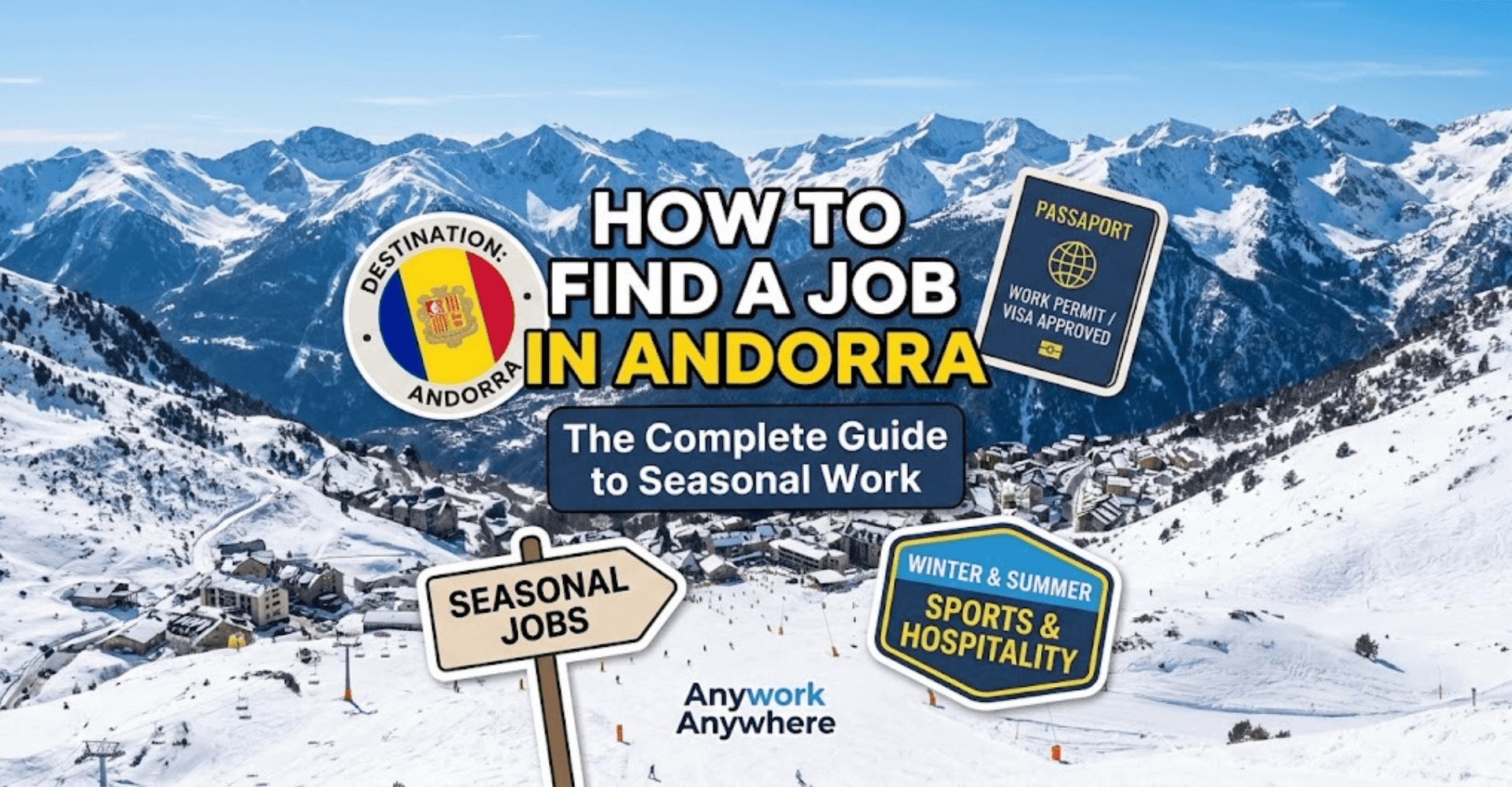
Living and Working in Andorra
Tucked away high in the Pyrenees mountains between Spain and France, the Principality of Andorra is one of Europe’s best-kept secrets for expats, seasonal workers, and digital nomads. Known for its breathtaking alpine scenery and over 300 days of sunshine a year, this microstate offers an unmatched outdoor lifestyle.
Beyond its world-class ski resorts like Grandvalira and Vallnord, Andorra stands out for having one of the lowest tax regimes in Europe (with a maximum income tax of just 10%), a virtually non-existent crime rate, and a thriving cosmopolitan community where Catalan, Spanish, French, and English blend seamlessly.
Whether you are looking to spend a winter season working on the slopes, grow your international career in hospitality or e-commerce, or relocate as a remote professional, living and working in Andorra is a truly unique experience.
Seasonal jobs in Andorra
Fun facts about Andorra
Official language: Catalan (Spanish, French, Portuguese, and English are also widely spoken)
Currency: Euro (€) (even though Andorra is not an official EU member)
Capital: Andorra la Vella (the highest capital city in Europe at 1,023 meters)
Population: Approx. 85,000 inhabitants
Time zone: CET (UTC+1) / CEST (UTC+2 in summer)
Famous for: World-class ski resorts, duty-free shopping, ultra-low taxes, and Pyrenees nature.
An interesting fact: Andorra has no airport, no train station, and no national army—and it consistently ranks among the safest countries in the world!
Working in Andorra
Does working abroad sound like your next big adventure? If you love mountain life, winter sports, and keeping more of your hard-earned paycheck, Andorra should be at the top of your list. Below, you will find everything you need to know about the Andorran job market, salaries, tax brackets, work culture, and how to land a job in Andorra.
The job market and working conditions in Andorra
Andorra’s economy is heavily driven by tourism, retail, hospitality, banking, and a rapidly growing digital and e-commerce sector. The country welcomes over 8 million visitors every year, creating a massive demand for international workers—especially during the winter ski season (December to April) and the summer mountain biking and hiking season.
The standard full-time workweek in Andorra is 40 hours per week (typically 8 hours a day over 5 days). By law, full-time employees are entitled to 30 calendar days of paid holiday per year (equivalent to 22 working days), in addition to public holidays.
Salaries in Andorra
Salaries in Andorra are competitive compared to neighboring Spain, and because income tax and social security deductions are remarkably low, your net take-home pay is very close to your gross salary.
The statutory minimum wage (Salari Mínim Interprofessional) in Andorra is approximately €1,376 to €1,400 gross per month for a 40-hour week. Meanwhile, the average gross salary in Andorra sits between €2,200 and €2,500 per month, depending on the industry and your level of experience.
Income tax in Andorra (IRPF)
One of the biggest advantages of working in Andorra is its progressive, ultra-low personal income tax system, known locally as IRPF (Impost sobre la Renda de les Persones Físiques). Tax residents in Andorra enjoy the following brackets on their annual income:
- Income from €0 to €24,000: 0% tax (completely tax-exempt)
- Income from €24,001 to €40,000: 5% tax
- Income above €40,000: 10% tax (the maximum tax rate in Andorra)
In addition to income tax, employees contribute just 6.5% of their gross salary to the Andorran social security system (CASS), while the employer covers the remaining 15.5%. Furthermore, Andorra’s standard value-added tax (known as IGI) is only 4.5%—the lowest in Europe!
Public holidays in Andorra
Andorra celebrates 14 official national public holidays each year, during which most businesses, banks, and government offices are closed:
- New Year’s Day (January 1)
- Epiphany / Three Kings’ Day (January 6)
- Carnival Monday (February/March – variable date)
- Constitution Day / Dia de la Constitució (March 14)
- Good Friday (March/April)
- Easter Monday (March/April)
- Labour Day (May 1)
- Whit Monday / Pentecost (May/June)
- Assumption Day (August 15)
- Our Lady of Meritxell – National Day of Andorra (September 8)
- All Saints’ Day (November 1)
- Immaculate Conception (December 8)
- Christmas Day (December 25)
- St. Stephen’s Day / Sant Esteve (December 26)
Work culture in Andorra
The business culture in Andorra is a blend of Catalan, Spanish, and French influences. Workplaces tend to be friendly and relationship-oriented, though traditional sectors like banking and law remain formal. In the hospitality, retail, and ski sectors, the atmosphere is international, fast-paced, and team-focused.
Languages in the workplace
While Catalan is the sole official language of the Principality (used in government and official documents), Spanish and French are spoken fluently by almost everyone in daily business. In tourism, ski resorts, international companies, and customer service roles, English is highly valued, though learning basic Spanish or Catalan will make your integration much smoother.
Seasonal jobs in Andorra: Ski resorts & hospitality
Every autumn, Andorra’s major ski domains—Grandvalira, Pal Arinsal, and Ordino Arcalís—along with hundreds of hotels, restaurants, and après-ski venues, recruit thousands of seasonal workers. Popular seasonal roles include:
- Ski and snowboard instructors
- Hotel receptionists and guest relations staff
- Bartenders, waiters, and kitchen staff
- Ski lift operators and rental shop technicians
- Retail sales assistants in duty-free shops
Keep in mind that hiring for the winter season usually starts between August and October. Many employers in the ski villages also help staff secure shared seasonal accommodation.
Remote work & Digital Nomads in Andorra
Thanks to its 100% fiber-optic internet coverage across all valleys, high safety standards, and favorable tax rates, Andorra has become a magnet for digital nomads, remote workers, and online entrepreneurs. The Andorran government offers a dedicated Digital Nomad Visa (Residència per a nòmades digitals) for remote employees and freelancers whose income comes from outside the Principality, as well as self-employed residency (residència per compte propi) for those setting up a local company.
How to find a job in Andorra
To land a job in Andorra, start by updating your LinkedIn profile and checking specialized international job boards. If you are aiming for winter seasonal work, apply directly through the ski resort portals (such as Grandvalira or Vallnord) late in the summer, or browse the official Servei d’Ocupació d’Andorra. For international roles, check our updated jobs in Andorra page regularly!
Living in Andorra
Pros and cons of living in Andorra
Moving to Andorra comes with extraordinary perks: you get clean mountain air, world-class nature right outside your door, ultra-low taxes, free trilingual public education (Andorran, Spanish, and French school systems), and a level of personal safety where people still leave their cars unlocked.
On the flip side, it is important to consider a few challenges: the rental market has become competitive and expensive due to limited buildable land in the valleys, there is no train or airport inside the country, and non-EU immigration paperwork requires preparation before you arrive.
Best places and parishes to live in Andorra
Andorra is divided into 7 administrative parishes (parròquies), each with its own vibe:
Andorra la Vella & Escaldes-Engordany
The bustling urban and commercial heart of the country. Ideal if you want to live without a car, walk to offices, enjoy shopping on Avinguda Meritxell, and relax at the famous Caldea thermal spa.
La Massana & Ordino
Located in the northwestern valley, these parishes are the top choice for international expats, digital nomads, and pro cyclists. Ordino is famous for its preserved stone architecture and tranquil mountain atmosphere, while La Massana offers direct gondola access to the Pal-Arinsal ski slopes.
Encamp, Canillo & Soldeu (Pas de la Casa)
The best parishes for winter seasonal workers and avid skiers, offering direct access to the Grandvalira ski domain. Encamp is also a popular, slightly more affordable commuter town just 10 minutes from the capital.
Accommodation and rental prices in Andorra
Rental prices in Andorra vary depending on altitude and proximity to the capital. A 1-bedroom apartment in the center of Andorra la Vella or Escaldes costs between €950 and €1,350 per month. In higher mountain parishes like Encamp, Arinsal, or Canillo, prices for a 1-bedroom flat range from €700 to €950 per month, while renting a room in a shared apartment typically costs between €400 and €650.
Here are the best websites to find an apartment in Andorra:
Temporary accommodation & hostels
If you are arriving in Andorra to look for seasonal work or waiting to sign a long-term lease, mountain hostels and coliving spaces cost between €25 and €45 per night. If you plan to arrive in November or December for the ski season, book well in advance as budget rooms fill up fast.

Cost of living in Andorra
Aside from rent, daily living expenses in Andorra are noticeably lower than in Western Europe thanks to the 4.5% VAT (IGI). A three-course menú del dia at a local restaurant costs around €13 to €16, a specialty coffee is €1.60 to €2.20, and a pint of beer is €3 to €4. Fuel, electronics, perfumes, and groceries are also cheaper than in neighboring France and Spain.
Crucial tip: Andorra is not part of the EU roaming zone! Using a standard European SIM card for mobile data in Andorra can result in huge roaming bills within minutes. Always turn off data roaming at the border, use Wi-Fi, or get a local prepaid SIM/eSIM from Andorra Telecom as soon as you arrive.
Transport and getting around in Andorra
Even without a train station or major airport inside its borders, Andorra is very well connected. Most residents fly into Barcelona-El Prat Airport (Spain) or Toulouse-Blagnac Airport (France), both located about 3 hours away, with daily direct coach services operated by Andbus and Directbus. There is also a regional airport just 30 minutes across the Spanish border at Andorra–La Seu d’Urgell with flights to Madrid and Palma de Mallorca.
Inside the country, an efficient network of interurban buses (L1 to L6) connects all seven parishes. A monthly unlimited bus pass costs around €30 for non-residents and is completely free for registered residents.
Driving, winter tires, and parking
Many expats choose to own a car to explore the mountains. Keep in mind that between November 1 and May 15, winter tires (or snow chains in your trunk) are mandatory by law. If you become an Andorran resident, you must exchange your foreign driver’s license for an Andorran one within your first year of residency.
Food and nightlife in Andorra
Andorran cuisine is hearty, authentic, and deeply rooted in the Pyrenees. The best place to experience local gastronomy is in a traditional Borda—a rustic stone mountain barn converted into a cozy restaurant. Must-try dishes include:
- Escudella: A rich traditional winter stew made with seasonal vegetables, pasta shells, and meats.
- Trinxat de muntanya: A delicious pan-fried cake of winter cabbage, potatoes, garlic, and crispy bacon.
- Cargols a la llauna: Baked snails served with spicy allioli sauce.
- Grilled meats & Fondue: Locally sourced Pyrenees beef and melted cheese fondues.
Après-ski and going out
While Andorra has a laid-back vibe during the week, its après-ski scene in winter is legendary. Venues like L’Abarset in El Tarter host international DJs every weekend, while the border town of Pas de la Casa is packed with lively pubs, clubs, and bars popular with young seasonal workers. In the capital, Andorra la Vella and Escaldes offer trendy cocktail bars and craft beer pubs.
Landscape and nature in Andorra
Over 90% of Andorra’s territory consists of untouched forest, alpine lakes, and high mountain peaks. The country boasts 65 peaks above 2,500 meters, the highest being Pic de Comapedrosa (2,942 m). Whether you are into skiing, snowboarding, trail running, road cycling (many Tour de France riders live here), or mountain biking, Andorra is an outdoor playground.

The climate in Andorra
Andorra enjoys a mountain Mediterranean climate with strong alpine influences. Unlike northern Europe, winters here are cold and snowy but remarkably bright and sunny. In winter (December to March), temperatures in the valleys average between -2°C and 8°C, dropping lower on the ski slopes. Summers (June to September) are dry, pleasant, and refreshing, with daytime highs between 22°C and 27°C—making it a fantastic escape from the scorching heatwaves of southern Europe.
Things to do in Andorra
Grandvalira & Vallnord Ski Resorts
With over 300 kilometers of ski slopes combined, Grandvalira, Pal Arinsal, and Ordino Arcalís form the largest ski area in the Pyrenees and one of the top winter sports hubs in Europe. In summer, the resorts transform into world-famous Bike Parks.
Caldea Thermal Spa
Located in Escaldes-Engordany, Caldea is the largest thermal spa complex in southern Europe. Housed in a striking glass pyramid tower, its natural hot spring lagoons (indoor and outdoor) are the ultimate spot to unwind after a day on the mountains.
Madriu-Perafita-Claror Valley
Covering nearly 10% of the entire country, this breathtaking glacial valley is a UNESCO World Heritage Site. With no paved roads allowed, it can only be explored on foot along ancient stone trails leading past high-altitude lakes and summer shepherd huts.
Roc del Quer Viewpoint & Canillo Tibetan Bridge
Suspended 158 meters above a dramatic canyon at 1,875 meters of altitude, the Tibetan Bridge of Canillo is one of the longest pedestrian suspension bridges in the world (603 meters). Nearby, the Roc del Quer viewpoint offers a panoramic platform suspended in mid-air.
Duty-Free Shopping on Avinguda Meritxell
Running through the heart of Andorra la Vella into Escaldes, The Shopping Mile is lined with hundreds of boutiques, department stores, and tech shops where visitors and residents take advantage of Andorra’s ultra-low taxes.
Healthcare in Andorra (CASS)
Andorra’s healthcare system consistently ranks among the best in the world. Public healthcare is managed by the CASS (Caixa Andorrana de Seguretat Social) and operates on a co-payment reimbursement model. Anyone legally employed in Andorra is automatically registered with the CASS.
Health insurance and coverage
Under the CASS system, public healthcare covers 75% of general medical visits, specialist consultations, and prescription medicines, 90% of hospitalization costs, and 100% of workplace accidents or maternity care. Many expats choose to take out a small supplementary private health insurance policy (complementària) for €30 to €50 a month to cover the remaining 25% co-payment.
Visa and work permit in Andorra
Although Andorra is not a member of the European Union, EU/EEA citizens do not need a tourist visa to enter the country for stays of up to 90 days. However, to legally work in Andorra, all foreigners (including EU citizens) must obtain a work and residence permit (Autorització d’immigració) before starting their job.
There are two main permits for employees: the seasonal work permit (permís de treball temporal, common for the winter ski season) and the active residence and work permit (residència i treball for long-term contracts). EU citizens receive priority in the annual immigration quotas. To apply, you will need a job offer from an Andorran company, a valid passport, a clean criminal record certificate with the Hague Apostille, and a basic medical check conducted by Inmigració upon arrival.
Safety in Andorra
Andorra is one of the safest countries on the planet. Violent crime and street theft are virtually unheard of, and walking alone at night in any town is completely safe. The only safety precautions you need to take involve mountain and winter weather safety (such as checking avalanche risks when skiing off-piste). The national emergency number is 112 (and 110 for the police).
Moving to Andorra: What do you need to arrange?
If you are ready to relocate to Andorra, here are the essential administrative steps to get settled smoothly:
Applying for your tax & administrative number (NIA)
When you process your work permit with the Andorran Immigration Department (Servei d’Immigració), you will be assigned a NIA (Número d’Identificació Administrativa). This is your personal identification and tax number in Andorra, which you will need for everything from signing contracts to paying taxes. Once you have an address, you must also register at your local parish town hall (known as the Comú).
Opening a bank account in Andorra
To receive your salary and set up your CASS social security reimbursements, you will need an Andorran bank account. To open one, bring your passport, your work contract, your immigration permit/NIA, and proof of local address. The three main retail banks in Andorra are Creand (Crèdit Andorrà), MoraBanc, and Andbank.
Frequently asked questions about living and working in Andorra
What is the average salary in Andorra?
The average salary in Andorra is between €2,200 and €2,500 gross per month, while the statutory minimum wage is approximately €1,376 to €1,400 per month. Because income tax is capped at 10% and social security contributions are only 6.5%, your net salary is much higher than in most EU countries for the same gross pay.
How much tax do you pay in Andorra?
Andorra has one of the lowest tax rates in Europe. The first €24,000 of annual income is taxed at 0%. Income between €24,001 and €40,000 is taxed at 5%, and any income above €40,000 is taxed at a flat maximum rate of 10%.
Do EU citizens need a work permit for Andorra?
Yes. Because Andorra is not an official member of the European Union, EU citizens must obtain an Andorran work permit (either a seasonal permit or an active residence permit) sponsored by a local employer before starting work. However, EU nationals enjoy a fast-track process and priority in the immigration quotas.
Is it expensive to live in Andorra?
While renting an apartment in Andorra has become more expensive in recent years (averaging €750 to €1,300 for a one-bedroom flat depending on the parish), everyday living costs such as groceries, dining out, fuel, and electronics are significantly cheaper than in Western Europe thanks to the low 4.5% VAT (IGI).
Read our top tips before starting your adventure working abroad